
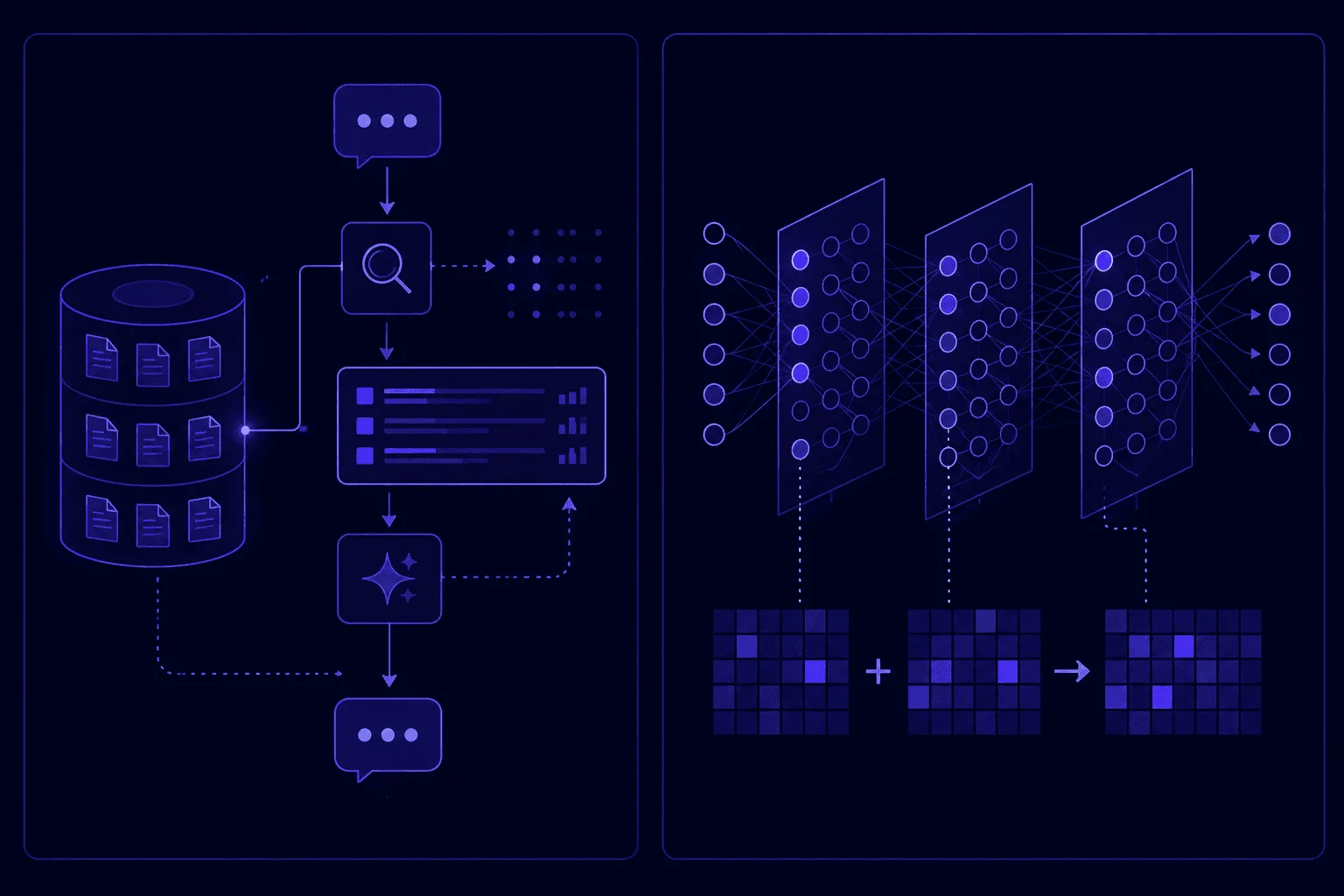
The choice between RAG and fine-tuning is not a philosophical debate: it is an engineering decision with concrete financial implications. RAG wins for dynamic knowledge bases that require citations. Fine-tuning wins for behavioral customization and output formatting. In production at scale, most mature deployments use both.
What is the difference between RAG and fine-tuning?
RAG modifies what the model sees at query time. Fine-tuning modifies the model weights permanently before deployment.
Both techniques address the same underlying problem: a general-purpose large language model trained on public data does not know your internal documentation, your products, or your organization’s specific terminology. They solve that problem at different layers of the stack.
RAG (Retrieval-Augmented Generation) indexes your documents in a vector database. When a user asks a question, the system retrieves the most relevant passages and sends them alongside the question to the language model. The model generates an answer grounded in those passages and can cite its source. The model itself is not modified. Updating your knowledge base is as simple as adding or removing documents from the index.
Fine-tuning re-trains the model weights on a curated dataset representative of your domain, style, or task. The result is a model that has internalized patterns, behaviors, and formats specific to your use case. However, those learned patterns are static: they reflect the training data at the time of the last run. If your underlying data changes significantly, you need to retrain.
The practical distinction: RAG changes what the model knows at inference time; fine-tuning changes how the model reasons and responds by default.
Gartner projects that more than 80% of enterprises will have deployed generative AI applications in production by the end of 2026, up from under 5% in 2023. Understanding which technique fits which use case is now a mandatory competency for enterprise AI architects.
When does RAG win for enterprise deployments?
RAG is the right default when knowledge changes regularly, citations are required, or deployment speed matters. It covers roughly 60% of enterprise GenAI production use cases.
RAG dominates enterprise deployments for four practical reasons.
Dynamic knowledge bases. Internal documentation, product catalogs, HR policies, support procedures, and regulatory content change continuously. With RAG, updating the knowledge base requires no retraining: you update the index and the model’s answers reflect the change on the next query. Fine-tuning would require a full re-run each time the underlying data shifts materially.
Source attribution and auditability. RAG grounds every answer in a retrievable document passage. Regulated industries (finance, healthcare, legal, insurance) require that every generated answer can be traced to a verified source. Fine-tuning cannot provide this: the model may recall patterns from training data, but there is no citation mechanism.
GDPR and data sovereignty. Documents indexed in a RAG system remain in your controlled storage layer. They are not baked into model weights, which means you can delete, update, or restrict access to any document and the model immediately stops using it. Fine-tuning embeds training data into the model, making precise removal of specific content technically complex.
Speed to production. A RAG deployment can reach production in days: ingest documents, configure retrieval, connect a model, and activate a channel. Fine-tuning typically requires weeks to months of dataset preparation, training, and evaluation.
Orange Business, in a technical assessment of enterprise AI architectures, describes RAG as “the most pragmatic, effective and reliable approach” for exploiting internal enterprise data. This aligns with observed deployment patterns: roughly 60% of enterprise GenAI production deployments rely on RAG over fine-tuned models, primarily for auditability and cost reasons, according to the State of AI Enterprise 2024 survey cited by Idun Group.
When does fine-tuning deliver better results?
Fine-tuning is the right tool when you need to change the model’s default behavior permanently: output format, tone, or reasoning on a narrow and stable task.
Fine-tuning is not a knowledge injection mechanism. It is a behavioral customization mechanism. Its strengths lie in specific areas.
Style and output format. If every response must follow a specific schema (a structured incident report, a legal clause format, a standardized customer email template), fine-tuning encodes that expectation directly into the model. Prompt engineering can approximate this, but a fine-tuned model applies the format consistently without relying on a long system prompt at every inference call.
Tone and domain vocabulary. Organizations with highly specific terminology, regulatory phrasing, or brand voice constraints can fine-tune a model to use that vocabulary naturally, without prompting overhead at each query.
Narrow, stable task performance. Classification tasks (ticket routing, intent detection), structured extraction (named-entity recognition in contracts), and domain-specific reasoning over stable subject matter benefit from fine-tuning because the task definition rarely changes.
Latency-critical applications. RAG adds a retrieval step that typically adds 200 to 600 milliseconds to response time. For applications requiring sub-100ms responses, a fine-tuned model without a retrieval step can be the better architectural choice.
The key constraint is stability. Fine-tuning is suitable when the domain is mature and the underlying data evolves infrequently. For anything that changes monthly or more often, the ongoing retraining cost and risk of stale model behavior make fine-tuning a poor fit. Idun Group’s 2025 enterprise AI analysis confirms that fine-tuning is recommended only when data is stable and task definitions are narrow, when latency is a hard requirement, or when output formats are highly standardized.
How do RAG and fine-tuning compare on cost?
Fine-tuning can cost 15 to 50 times more than RAG over a 12-month horizon, due to GPU compute, dataset creation, training cycles, and ongoing retraining requirements.
The total cost of fine-tuning a model for enterprise use includes five categories that teams routinely underestimate.
Dataset creation. Collecting, cleaning, annotating, and structuring training examples from internal data typically takes weeks of effort and can require external annotation cost, even with a clean starting corpus.
GPU compute. Training and evaluation runs on accelerated hardware, either via cloud APIs (OpenAI, AWS, Azure) or self-hosted infrastructure, scale with model size and the number of training iterations needed to reach acceptable quality.
Iterative cycles. A single fine-tuning run rarely produces a production-ready model. Three to five iterations with evaluation between each run is a realistic expectation, multiplying both compute cost and calendar time.
MLOps infrastructure. A deployment pipeline for the fine-tuned model, monitoring for performance degradation over time, and a rollback mechanism are non-trivial operational commitments that persist after the initial launch.
Retraining cadence. Each time the underlying data shifts significantly (new product lines, regulatory changes, organizational restructuring), the cycle restarts.
RAG costs, by contrast, are linear and predictable: compute for indexing new documents, plus inference costs per query. There is no retraining cycle. Updates to the knowledge base are operational tasks, not engineering projects.
Idun Group’s 2025 cost comparison estimates that fine-tuning costs 15 to 50 times more than a well-architected RAG system on a 12-month horizon, and that RAG can be up to 90% cheaper for dynamic knowledge base scenarios. Databricks confirms that RAG extends LLM capabilities without expensive retraining by incorporating live business data at each query.
How do you decide which approach fits your situation?
Start with this matrix: if knowledge changes frequently or citations are required, start with RAG. Add fine-tuning only after identifying behavioral gaps you cannot close with prompting.
| Criterion | RAG | Fine-tuning |
|---|---|---|
| Knowledge update frequency | Ideal for frequent updates | Requires retraining per update cycle |
| Source citation requirement | Native (every answer cites a passage) | Not available |
| GDPR data sovereignty | Documents stay in controlled index | Data baked into model weights |
| Time to first deployment | Days to weeks | Weeks to months |
| Budget (12-month TCO) | Low (indexing and inference only) | High (GPU, dataset, MLOps) |
| Inference latency | Adds 200 to 600ms for retrieval | Faster with no retrieval step |
| Behavioral customization (tone, format) | Partial via system prompt | Strong, encoded in model weights |
| Task stability requirement | Works well for evolving domains | Best for stable, narrow tasks |
| Hallucination risk mitigation | High (grounded in source documents) | Lower than baseline, but no citations |
For most enterprise teams in 2026, the default recommendation is to start with RAG. It solves 80% of knowledge-access problems without requiring ML infrastructure or annotated training data. It is also more forgiving: if retrieval quality is poor, you tune the index, not the model. Add fine-tuning only after running RAG in production and identifying specific behavioral gaps that prompt engineering cannot close.
How do you combine RAG and fine-tuning in a production system?
The dominant production pattern at scale is RAFT: fine-tune for behavioral alignment, then layer RAG for fresh and citable knowledge at query time.
The term RAFT (RAG-Augmented Fine-Tuning) refers to an approach where a model is fine-tuned specifically to reason well over retrieved context, making the two techniques explicitly complementary rather than alternatives. Researchers at UC Berkeley published the RAFT method in 2024, demonstrating that fine-tuning a model to operate well with retrieved documents outperforms either technique alone on domain-specific question-answering benchmarks.
In practical enterprise terms, the combined architecture works as follows.
Step 1: fine-tune the base model on a curated dataset that encodes your behavioral requirements: your corporate tone, your output formats, your handling of edge cases. This run happens once (or infrequently) and shapes how the model responds.
Step 2: layer RAG to supply the factual content, including your current documentation, policies, product data, and support materials. This layer is updated continuously as your knowledge base evolves.
Step 3 (query time): the system retrieves relevant passages from the RAG layer and passes them to the fine-tuned model, which applies its behavioral calibration to generate a consistent, well-formatted, citable answer.
The result is a model that speaks in your voice, follows your formats, and always answers from your latest documents, with every response traceable to a source.
Per Menlo Ventures’ 2025 enterprise AI survey, 76% of enterprise AI use cases are now purchased rather than built in-house, up from 53% in 2024. For teams that choose to build, the RAG-plus-fine-tuning architecture is becoming the standard pattern for mature deployments where behavior consistency and knowledge freshness both matter.
What is the recommended migration path from RAG to a combined architecture?
Start with RAG on a general-purpose base model. Validate on real traffic for 60 to 90 days, then add fine-tuning for specific behavioral gaps only.
This sequence minimizes sunk costs and maximizes what you learn from real user interactions before committing to the higher investment of fine-tuning.
Phase 1: RAG deployment (weeks 1 to 4)
Deploy a RAG pipeline on a capable general-purpose model. Index your priority document corpus, configure hybrid retrieval (vector search combined with keyword search for precision), and activate the channel your users will access. Focus on getting real usage data, not on perfecting the model before launch.
Phase 2: evaluation (months 2 to 3)
Instrument retrieval quality: measure whether retrieved passages are relevant, track citation accuracy, and collect user feedback on response quality. Identify the failure modes that are specific to your domain. Are answers tonally inconsistent? Does the model misformat outputs in specific task categories? Does it struggle with a particular type of query? These are the signals that justify fine-tuning investment.
Phase 3: targeted fine-tuning (if warranted)
If evaluation reveals behavioral gaps that cannot be closed by prompt engineering or retrieval improvements, scope a fine-tuning run targeted at those specific gaps. Prefer parameter-efficient methods (LoRA or QLoRA) over full fine-tuning to reduce compute cost. Deploy the fine-tuned model as the base layer and keep your RAG index feeding it context at query time.
The MIT 2025 State of AI in Business report found that roughly 95% of enterprise GenAI pilots never reach scaled production. The teams that make it past the pilot stage are those that start with the fastest path to real usage data (RAG), then invest in customization (fine-tuning) based on evidence from production, not assumption from a design session.
What are the most common mistakes teams make when choosing between RAG and fine-tuning?
The two classic errors are mirror images: fine-tuning when RAG would have been faster and cheaper, and using RAG when the real problem is behavioral and not informational.
Mistake 1: fine-tuning to inject knowledge.
The most expensive and frequent mistake in enterprise AI is treating fine-tuning as a knowledge database. Teams collect documentation, annotate it into training examples, run a fine-tuning job, and then discover that the model still hallucinates on specific facts, has no citation mechanism, and requires a new training run the next time a policy changes. Fine-tuning cannot reliably store and retrieve specific facts the way a vector database can. Use RAG for knowledge; use fine-tuning for behavior.
Mistake 2: using RAG when the problem is behavioral.
The inverse mistake is deploying RAG and expecting it to fix output consistency. If your model keeps responding in the wrong tone, generating poorly structured outputs, or mishandling a specific class of queries regardless of what documents are retrieved, no amount of retrieval tuning will fix those problems. They require either a better system prompt, a model with stronger base capability for your task, or a targeted fine-tuning run.
Mistake 3: scaling fine-tuning infrastructure before validating RAG.
Some teams invest in fine-tuning infrastructure before deploying RAG, on the assumption that model customization is the priority. This is a sequencing error. RAG gives you a working system quickly and reveals which behavioral gaps are real versus hypothetical. Investing in fine-tuning before validating on real production traffic is a common reason enterprise AI projects stall well before they reach scaled deployment.
For a deeper look at deploying RAG in enterprise contexts, see the enterprise RAG platforms comparison guide and the self-hosted RAG deployment guide. GuardWeaver is a managed no-code RAG platform that gives enterprise teams a production-ready system in days, with SaaS and on-premise deployment, hybrid retrieval, multi-LLM support, and document-level access control. Compare the offers or book a demo to test it against your own documents.